

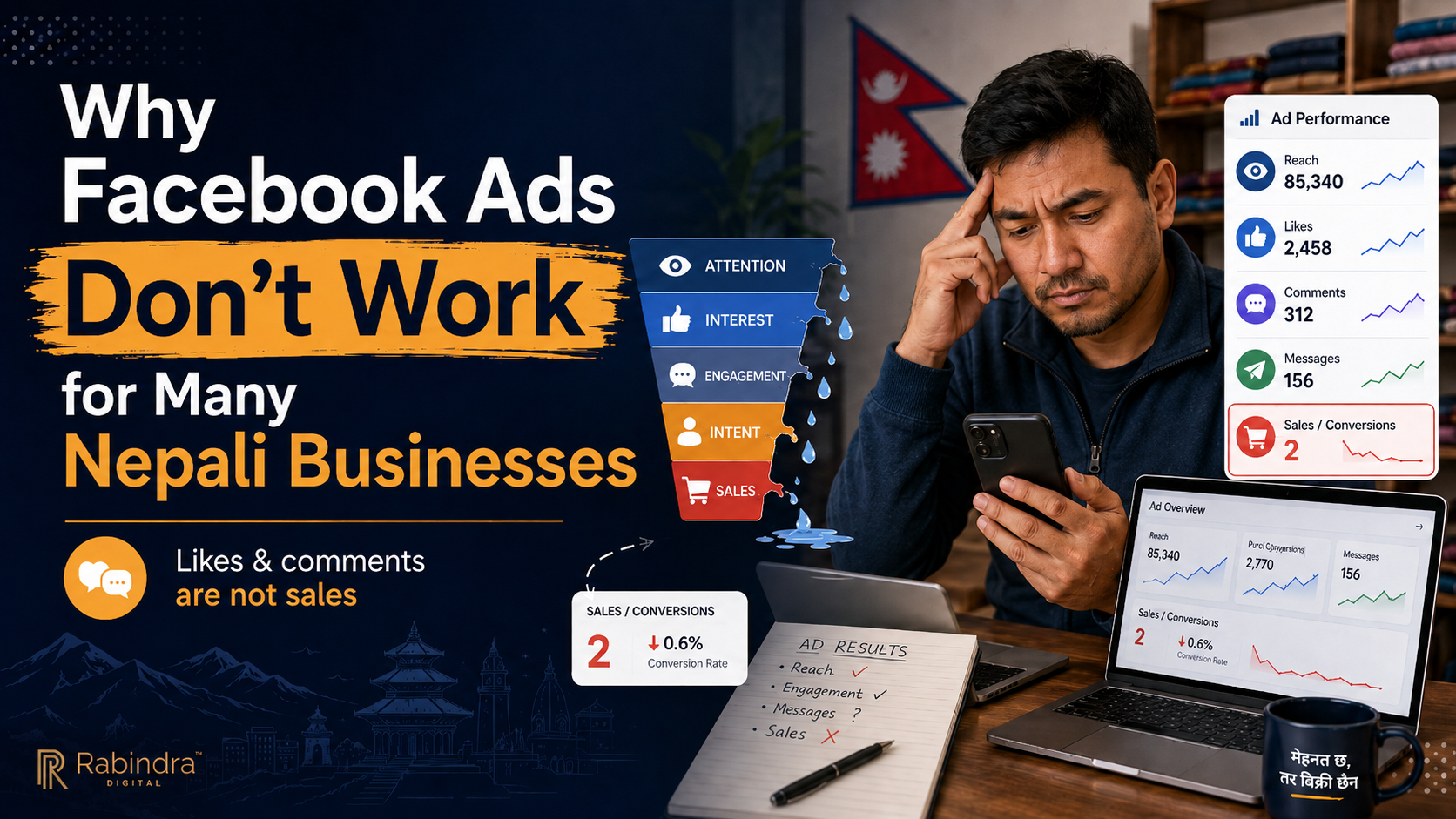
Many business owners wonder why Facebook Ads Don’t work for them! If your Facebook or Meta boost is giving you only likes and comments, but no orders, sales, or real conversions, you are not alone.
I have come across many small and medium business owners in Nepal who face the same problem. They are spending a significant amount on ads, but not seeing enough return. Naturally, this creates frustration. Some business owners even reach a point where they start questioning whether their business itself can survive.
If you are in that situation, this article is for you.
This is why many business owners search for why Facebook ads don’t work in Nepal, but the real answer is usually deeper than the ad itself.
In the next 5–10 minutes, you will get a clearer picture of why Facebook ads in Nepal do not always bring results by themselves — and what practical steps you can take to improve your sales, leads, and conversions.
Why Facebook Ads Alone May Not Be the Real Problem
Many business owners immediately blame Facebook ads when they do not get sales. But in reality, Facebook ads are only one part of the marketing system.
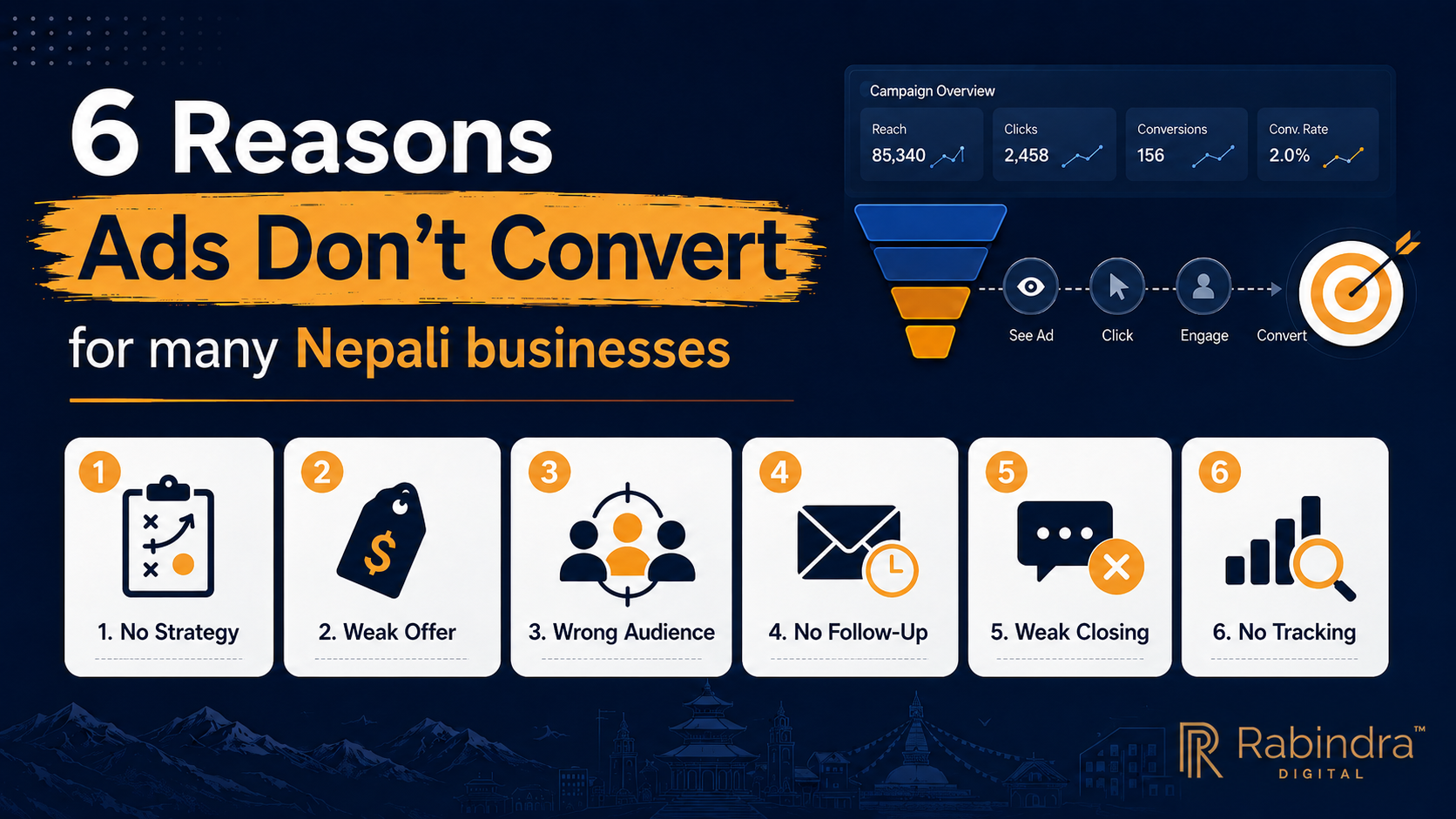
Ads can bring attention, reach, clicks, messages, or visitors. But after that, many other things decide whether that person becomes a customer or not.
For example, your ad may be bringing people to your WhatsApp, but if the reply is slow, unclear, or only says “price is Rs. X,” the customer may disappear. Your ad may be getting clicks, but if your offer is not attractive, people may not take action. Your post may be getting comments, but if there is no follow-up system, those comments may never turn into sales.
So before saying “Facebook ads don’t work,” we need to ask a better question:
Where exactly is the customer dropping off?
To understand why Facebook ads don’t work, we need to look at the full journey from seeing the ad to becoming a paying customer. That is where a proper digital marketing strategy in Nepal becomes important. It is not only about running ads. It is about understanding how attention turns into inquiry, and how inquiry turns into sales.
Reason 1: Boosting Posts Without Strategy
“My strategy is to boost and get as many customers as I can,” one of my clients replied when I asked him what digital marketing or ad strategy he was using. He owns a clothing store in Kathmandu. He added, “It used to work until a couple of years ago, but now it has stopped working.”
This is a common situation. Something that worked one or two years ago may not work the same way today. Digital platforms keep changing — with AI, machine learning, algorithms, competition, customer behaviour, and many things happening behind the scenes.
One major reason why Facebook ads don’t work for many businesses is that they boost posts without a clear strategy.
At a basic level, a business should first identify its hero products or services, understand who the target customers are, build an irresistible offer around them, and create an ad campaign with the right objective — for example, sales, leads, messages, or traffic. The goal should not be only to get more likes or comments, but to create interest and move the customer toward action.
This is why Meta ads for Nepali businesses need to be planned carefully. Simply boosting posts may bring engagement, but it may not create a predictable customer journey.
For example, ads do not complete the sale by themselves, especially in Nepal’s clothing business. Ads create interest, but Messenger or WhatsApp often closes the order. So if effective communication is not practiced, you may lose the customer even after getting the inquiry.
Suppose someone asks the price of a product they saw in your ad. If the team only replies, “Rs. 1,199,” and waits, many customers will disappear. But if the team guides the customer, recommends size, shows a product video, explains delivery or COD options, and asks for order details, the chance of conversion improves.
So the problem is not always that Facebook ads do not work. The problem is that many businesses are using ads without a proper strategy behind them.
Reason 2: Weak Offer and Unclear Message
An offer is what makes a product or service appealing to the customer. It should highlight the value the customer gets from it. After seeing the offer, the customer should be able to imagine themselves using or buying that product.
Many clothing businesses in Nepal, for example, think that if they offer a good discount, they should be able to sell more products. But discount is only one type of offer. Sometimes, a discount is not even needed if the product price is already reasonable.
For instance, one of my clients had this offer style:
Current offer style:
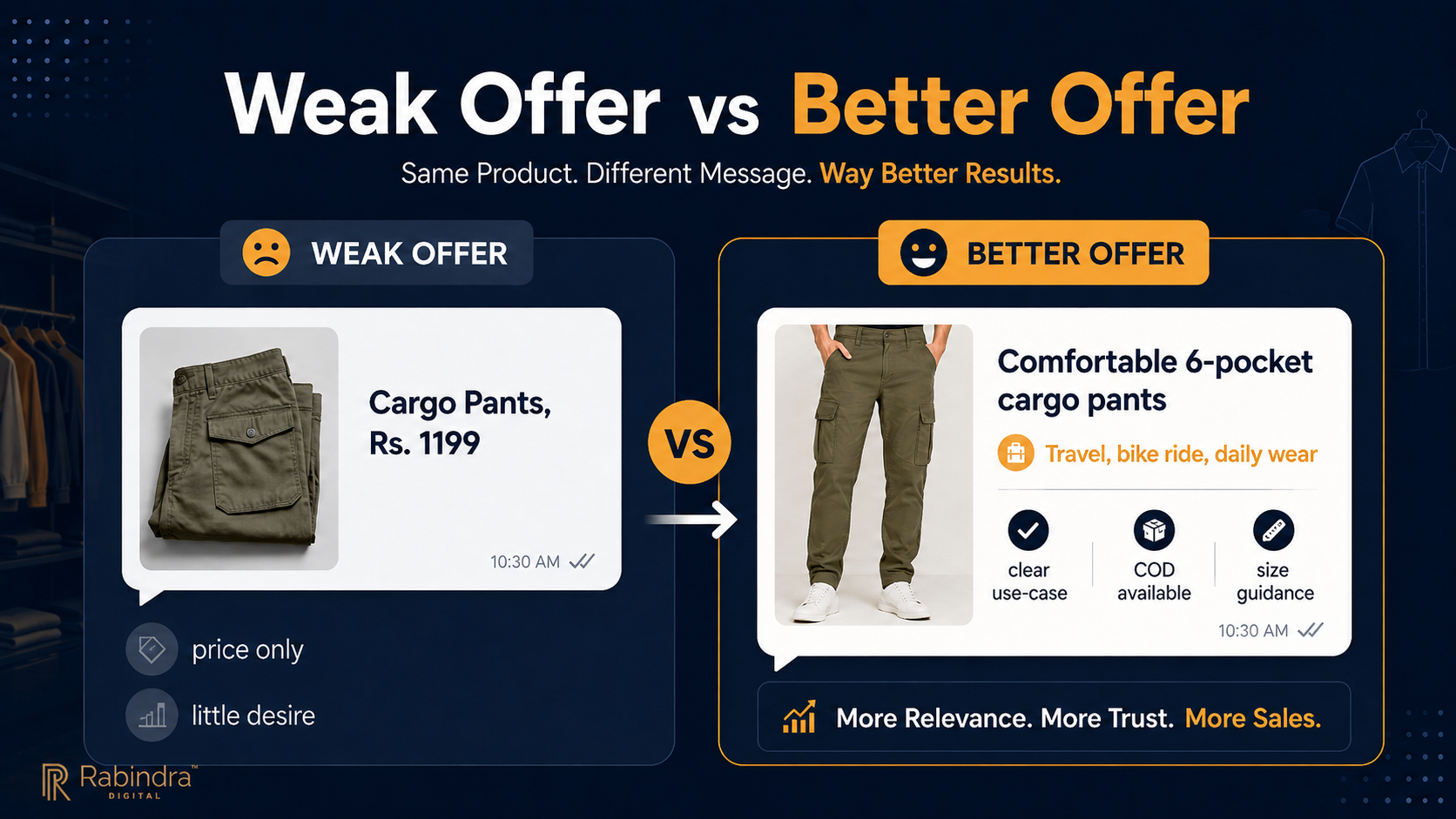
“Cargo Pants, Rs. 1,199. Buy now before stock out. COD available.”
This gives some information, but it does not create enough desire or help the customer visualize the product.
A better offer style could be:
Better offer style:
“For travel, bike ride, or daily wear — comfortable 6-pocket cargo pants with stretchable outdoor fit. All-Nepal delivery and COD available. Message us with your waist size and we’ll recommend the right fit.”
The second offer instantly gives a use-case for the product. The customer can imagine when and why they might need it. It also reduces confusion by guiding them on what to do next.
So, Nepali businesses need to be more creative with their offers. A better offer is not always about giving a cheaper price. Sometimes, it is about explaining the product better, reducing customer doubt, showing practical use, and making the next step easy.
If the offer is weak, even a good ad may only bring likes, comments, or price inquiries — not real sales. This is another important reason why Facebook ads don’t work for businesses that have not clearly communicated their value.
Reason 3: Wrong Audience and Low-Quality Leads
You may be excited seeing the “impressions” and “reach” from the ad you ran. You may even get many people reaching out to you through messages. But the important question is: did you get the right people?
During a marketing audit of one of my clients, I found that around 75% of the messages were only about price. The business also told me that most of those people did not buy, even though it was a low-ticket item.
This means the ad may be generating activity, but not necessarily serious buyers.
You need to apply filters. This can happen through your targeting, ad copy, creative, and even your WhatsApp questions or sales script. The purpose is not to reject customers, but to attract and identify the serious ones.
This is an important part of lead generation in Nepal. Getting more leads is not enough. A business needs the right leads — people who have interest, need, budget, and some level of buying intent.
Continuing with our clothing store example, if the ad for cargo pants says, “If you are usually outdoors and enjoy cycling, hiking, travel, or camping, these flexible cargo pants are for you,” it already helps attract a more relevant audience.
The lesson here is simple: the goal of advertising is not just to get more people to message you. The goal is to attract the right people and guide them properly. If your ad brings many low-intent inquiries, your team becomes busy, but sales may still remain low. So before increasing the budget, first check whether your ad message, targeting, and inquiry-handling process are filtering for serious buyers.
Reason 4: There Is No Proper Follow-Up System
Many businesses lose customers after the first message. Someone may ask about price, size, delivery, or availability. The business replies once, and if the customer does not respond immediately, the conversation ends there.
But customers do not always buy instantly. They may be comparing options, checking with family, waiting for salary, or simply distracted.
For example, if someone asks about cargo pants and does not reply after seeing the price, a simple follow-up can help:
“Hello, do you need help choosing the right size? COD and all-Nepal delivery are available.”
This small follow-up can bring back a customer who was already interested. So, if you are spending money on ads but not following up properly, you may be losing sales that were almost possible.
A proper follow-up system does not mean disturbing the customer again and again. It means politely helping them make a decision and reminding them of the value they already showed interest in.
Reason 5: Weak Sales and Closing Process
Ads create attention, but the sales conversation closes the order.
This is especially true for businesses that sell through Messenger, WhatsApp, phone calls, or direct messages. The customer may come from the ad, but the final decision depends on how well your team handles the conversation.
A weak reply looks like this:
“Rs. 1,199.”
A better reply looks like this:
“Yes, it is Rs. 1,199. This cargo pant is stretchable and comfortable for travel, bike rides, and daily wear. Which waist size do you usually wear?”
The second reply does not only answer the price. It guides the customer toward a decision.
So, if your team is only replying to questions but not helping customers decide, your ads may bring messages, but not enough sales.
For many businesses, improving the sales conversation can immediately improve results without even increasing the ad budget.
Reason 6: No Tracking Beyond Likes and Messages
Many businesses judge ads only by likes, comments, reach, and messages. These numbers are useful, but they do not show the full business result.
An ad may get 500 likes and 100 messages, but the real questions are:
How many people were serious buyers?
How many gave their order details?
How many actually purchased?
How much revenue came from that ad?
How much money was spent to get one sale?
Without tracking these numbers, it becomes difficult to know why Facebook ads don’t work or where the money is leaking.
At minimum, a business should track cost per message, number of qualified inquiries, number of orders, sales value, and follow-up conversion. If you do not track the journey, you cannot know where the money is leaking.
This is where a marketing funnel for small business becomes useful. It helps you see each step clearly: ad view, message, inquiry quality, follow-up, order, and repeat purchase.
What Nepali Businesses Should Fix First
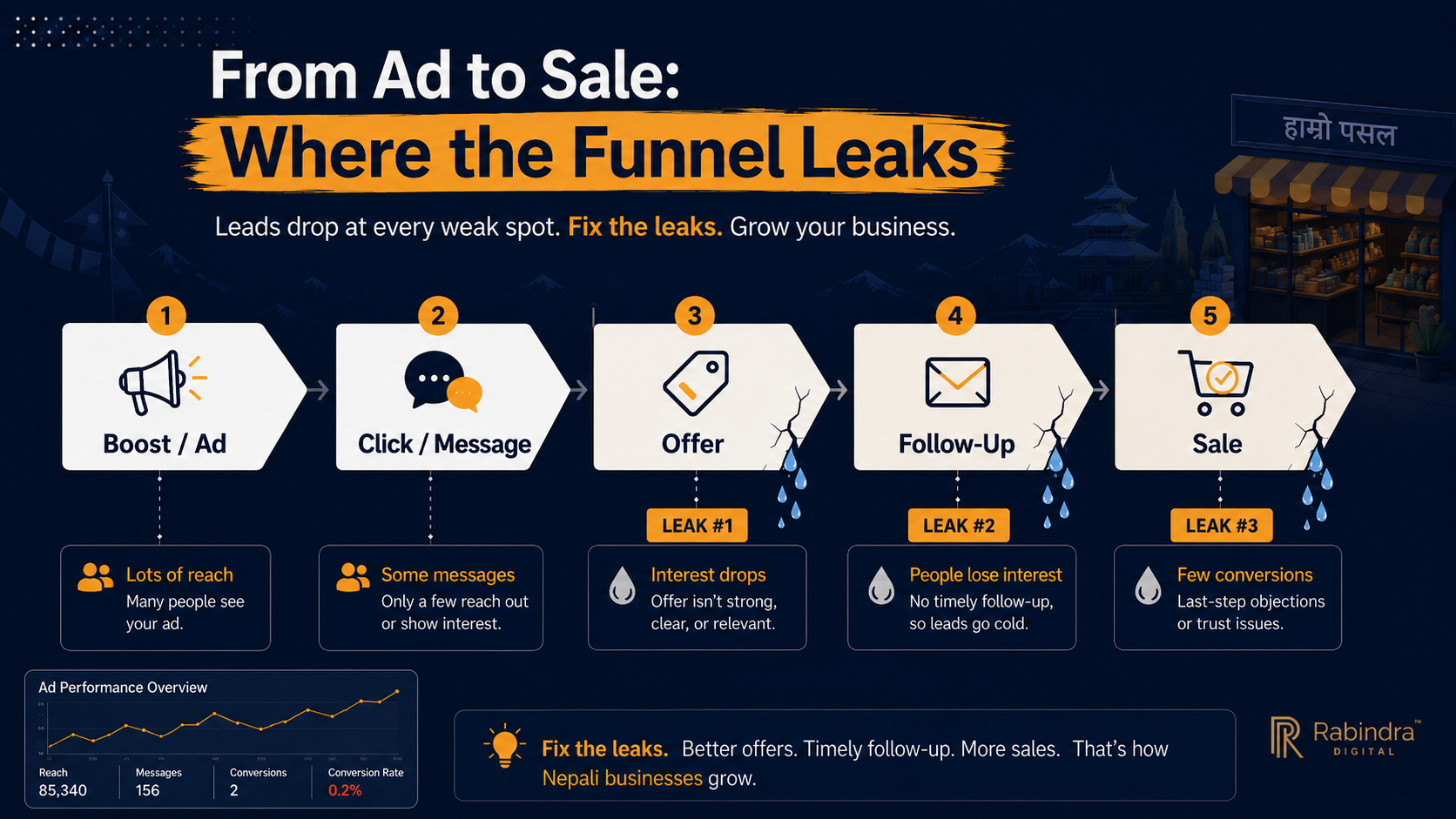
Before spending more money on Facebook ads or boosting, Nepali businesses should first check the full customer journey.
Start with these questions:
Is the product clear?
Is the offer strong?
Are we targeting the right people?
Does the ad message create real interest?
What happens after someone messages us?
Do we follow up?
Are we tracking sales, not just likes?
Facebook ads can work. But they work better when they are connected to a proper system.
If the offer is weak, the audience is wrong, the WhatsApp reply is poor, and there is no follow-up, increasing the ad budget may only increase waste. But if the full funnel is improved, the same ad budget can produce better results.
This is the foundation of a practical business growth strategy for Nepali businesses — not just more ads, but better strategy, better follow-up, and better conversion.
Conclusion: Facebook Ads Are Only One Part of the System
So, if you are trying to understand why Facebook ads don’t work, do not look only at the ad. Look at your strategy, offer, audience, follow-up, closing, and tracking.
The real problem may be your strategy, offer, audience, follow-up, sales process, or tracking system.
Ads are only one part of digital marketing. They can bring people to your business, but the full system must convert those people into customers.
Before you spend more money on boosting, take a step back and look at your complete marketing funnel. Find out where people are dropping off. Fix that part first.
If you are a Nepal-based business owner and want to understand why your ads are not converting into real sales, Rabindra Digital can help you review your current marketing system and build a practical digital growth strategy.
As a digital marketing consultant in Nepal, my focus is not only to run ads, but to help businesses understand the full journey from attention to conversion.